
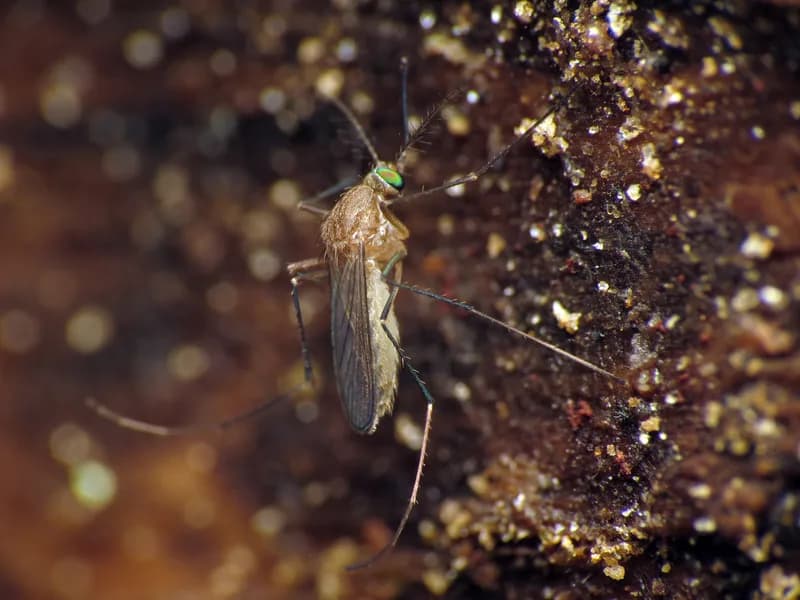
Mosquitoes treatment in Chicago
Yard and property mosquito work — the standing water they breed in, and the shaded harbourage the adults rest in by day.
Only the females bite; they need a blood meal to develop eggs. Everything else about the job comes down to two things — where the water is that they are breeding in, and where the adults are spending the day.
The species most Chicago households are dealing with is the northern house mosquito, Culex pipiens. It breeds in stagnant, organically rich water rather than clean water, which is why it thrives in a city: alley catch basins, clogged gutters, a tarp with a dip in it, a plant saucer, a wheelbarrow, a forgotten bucket behind the garage. A bottle cap of water is genuinely enough to produce adults, and the cycle from egg to biting adult runs in about a week in July heat.
Adults do not spend the day in the open. They rest somewhere cool and shaded and humid — the undersides of leaves in dense shrubs, ivy, the shaded side of a fence line, under a deck, inside a gangway between buildings. That is where a treatment does its work. Fogging an open lawn looks like something is being done and knocks down what happens to be flying at that moment; treating the resting harbourage is what changes the evening.
So the job runs in that order: walk the property and find every source of standing water, remove what can be removed, treat with a larvicide the water that cannot be removed, then treat the resting harbourage for the adults. Small city lots share problems — a neighbour's untouched yard or the catch basin in the alley will keep feeding the property, which is worth knowing before anyone expects a treated yard to stay empty.
Chicago's season runs from roughly May to October and bites hardest from late July into August. Treatment is not permanent: heat, rain and time all shorten it, so most properties want it repeated across the season. As with everything else here, each visit is booked when you want it, priced before the work starts, and there is nothing to sign.
Signs you have mosquitoes
- Biting at dusk and dawn, and indoors near doors and windows
- Standing water in gutters, saucers, tarps, buckets, tyres or a wheelbarrow
- Clusters of mosquitoes lifting out of dense shrubs or ivy when disturbed
- Bites concentrated in one shaded part of the yard
- Larvae — small wrigglers — visible in a container of standing water
How we treat them
- Property walk to find every source of standing water, including the ones behind the garage
- Source reduction first — the water that can simply be emptied or drained
- Larvicide for the water that cannot be removed, such as a catch basin or a low spot
- Targeted treatment of the shaded daytime resting harbourage, not blanket fogging of open lawn
- Repeat visits across the season as you want them — no plan, no auto-renewal
Common questions
I have no pond — where are they breeding?
Almost never anywhere obvious. The northern house mosquito prefers stagnant, dirty water over clean water, so the source is usually a clogged gutter, an alley catch basin, a tarp holding a puddle, a plant saucer or a bucket behind the garage. A bottle cap of water is enough.
How long does a mosquito treatment last?
A few weeks in peak season, and less after heavy rain or a run of very hot days. It is not permanent and nobody should tell you it is. Most properties have it repeated through the summer — booked when you want it, not on a plan.
Will it hurt bees or butterflies?
The treatment goes on the shaded harbourage where mosquitoes rest, not on flowering plants, and it is applied at the times of day pollinators are not foraging. If you keep bees or have planted for pollinators, say so when you call and we will plan around it.
Do I need to do anything before the visit?
Empty anything holding water — saucers, buckets, toys, tyres, the bottom of a tarp — and clear the gutters if they are blocked. That is not busywork; it removes breeding sites that no treatment reaches.
My neighbour does nothing — is it still worth treating?
Yes, but it changes what to expect. Mosquitoes cross a lot line, so on a small city lot next to an untreated yard the biting comes down considerably rather than stopping. We will tell you honestly what your property can achieve before you book anything.
Where we treat mosquitoes
We cover mosquitoes across Chicago, with most of our work in these neighbourhoods. If you are not sure whether we reach you, call and ask.
Other pests we treat
Dealing with mosquitoes?
No contracts, no plans, nothing to cancel — and every job priced before the work starts.
Request a quote
Tell us what you're seeing.
The more you can tell us up front — where, how long, how many — the better prepared we arrive. Most of the time we can narrow the species down before we even get there.
- No contracts — you book us when you need us, and never before
- We identify the species properly before quoting anything
- The job is priced before the work starts, and agreed with you first
- Specialists in moths in wool, silk, cashmere and fine rugs
- Organic and IPM-led options, safe around children and pets
Request a quote
We'll get back to you to arrange a time to come and look.