Moths treatment in Chicago
The moth service Chicago's designers and rug wholesalers pass on. Wool, silk, cashmere and hand-knotted rugs.
Moths are the work we are best known for. We treat for private homes, for designers, and for the rug wholesalers that supply them — and we are the number one moth service across the neighbourhoods we cover.
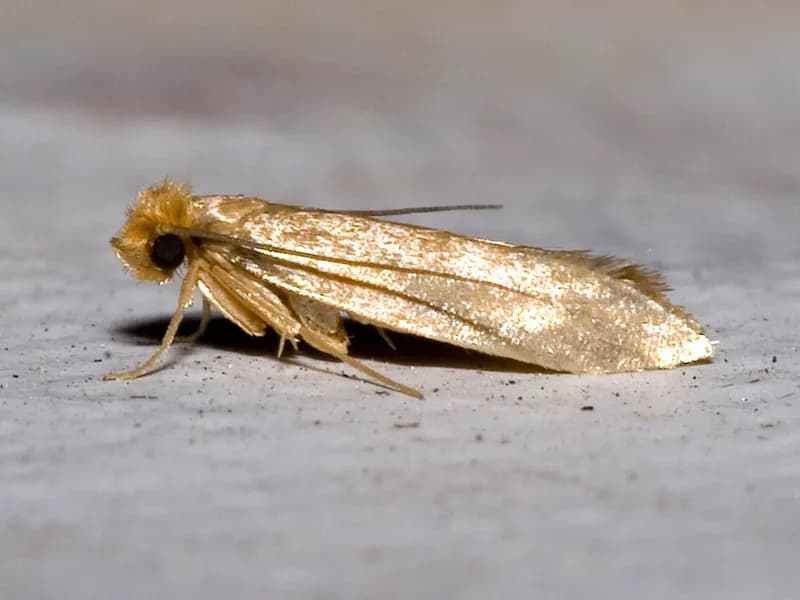
Clothes moths are the expensive variety. Their larvae feed on natural protein fibres: wool, cashmere, silk, fur and feathers. They favour dark, undisturbed places — the back of a wardrobe, a stored winter coat, a hand-knotted rug under a piece of furniture that never moves. The damage is irregular holes and thinned pile, and it is done by the larvae, not the adults you see flying.
That is why the trade calls us. A designer's install or a wholesaler's stock cannot be treated the way a baseboard can — the piece has to come through it unmarked. We work around pile, dye and backing, treat the harbourage and the voids where larvae pupate rather than saturating the textile itself, and tell you plainly when a piece needs specialist cleaning rather than treatment.
Indian meal moths are the other variety, and a completely different job. They infest dry goods — flour, grains, cereal, nuts, dried fruit, pet food, birdseed — and are very often brought into the house already inside a sealed package. The giveaway is silken webbing and small caterpillars in the food itself, and adults fluttering along the tops of kitchen walls and ceilings.
For both, the work is the same shape: inspection to find every infested item, removal and disposal, treatment of the voids and cracks where larvae pupate, and pheromone monitoring to confirm it is genuinely over. And as with everything we do, the job is priced before we start and there is no contract attached.
Signs you have moths
- Irregular holes or thinned patches in wool, cashmere, silk or fur
- Damage to the underside of a rug where furniture has sat undisturbed
- Silken tubes, cases or grit-like frass in wardrobe corners and rug fringes
- Small moths flying along the tops of kitchen walls and ceilings
- Webbing, clumping or small caterpillars in dry food packages
How we treat them
- Full inspection of textiles, storage and rug backs to find every source
- Treatment planned around pile, dye and backing — the piece comes through it unmarked
- Harbourage, crack, void and shelf-edge treatment where larvae pupate
- Coordination with designers, rug wholesalers and specialist cleaners where a piece needs it
- Pheromone monitoring to confirm the infestation is finished
Common questions
Will treatment damage a wool or silk rug?
No. That is the whole reason the trade uses us. We treat the harbourage, the backing environment and the voids where larvae pupate rather than saturating the textile, and we plan around pile, dye and backing. Where a piece needs specialist cleaning rather than treatment, we say so instead of working on it.
Do you work with designers and rug wholesalers?
Regularly. We work directly with designers and with rug wholesalers across Chicago — on their stock, on their showrooms and in their clients' homes. If you are in the trade and need a moth problem handled discreetly, call us.
Do the flying moths eat my clothes?
No — the larvae do all the damage. By the time you see adults flying, feeding has already happened somewhere nearby.
How did pantry moths get into sealed packages?
They usually arrive already inside them. Infestation typically happens upstream at a processing or storage facility, not in your kitchen.
Where we treat moths
We cover moths across Chicago, with most of our work in these neighbourhoods. If you are not sure whether we reach you, call and ask.
Read next
Other pests we treat
Dealing with moths?
No contracts, no plans, nothing to cancel — and every job priced before the work starts.
Request a quote
Tell us what you're seeing.
The more you can tell us up front — where, how long, how many — the better prepared we arrive. Most of the time we can narrow the species down before we even get there.
- No contracts — you book us when you need us, and never before
- We identify the species properly before quoting anything
- The job is priced before the work starts, and agreed with you first
- Specialists in moths in wool, silk, cashmere and fine rugs
- Organic and IPM-led options, safe around children and pets
Request a quote
We'll get back to you to arrange a time to come and look.